
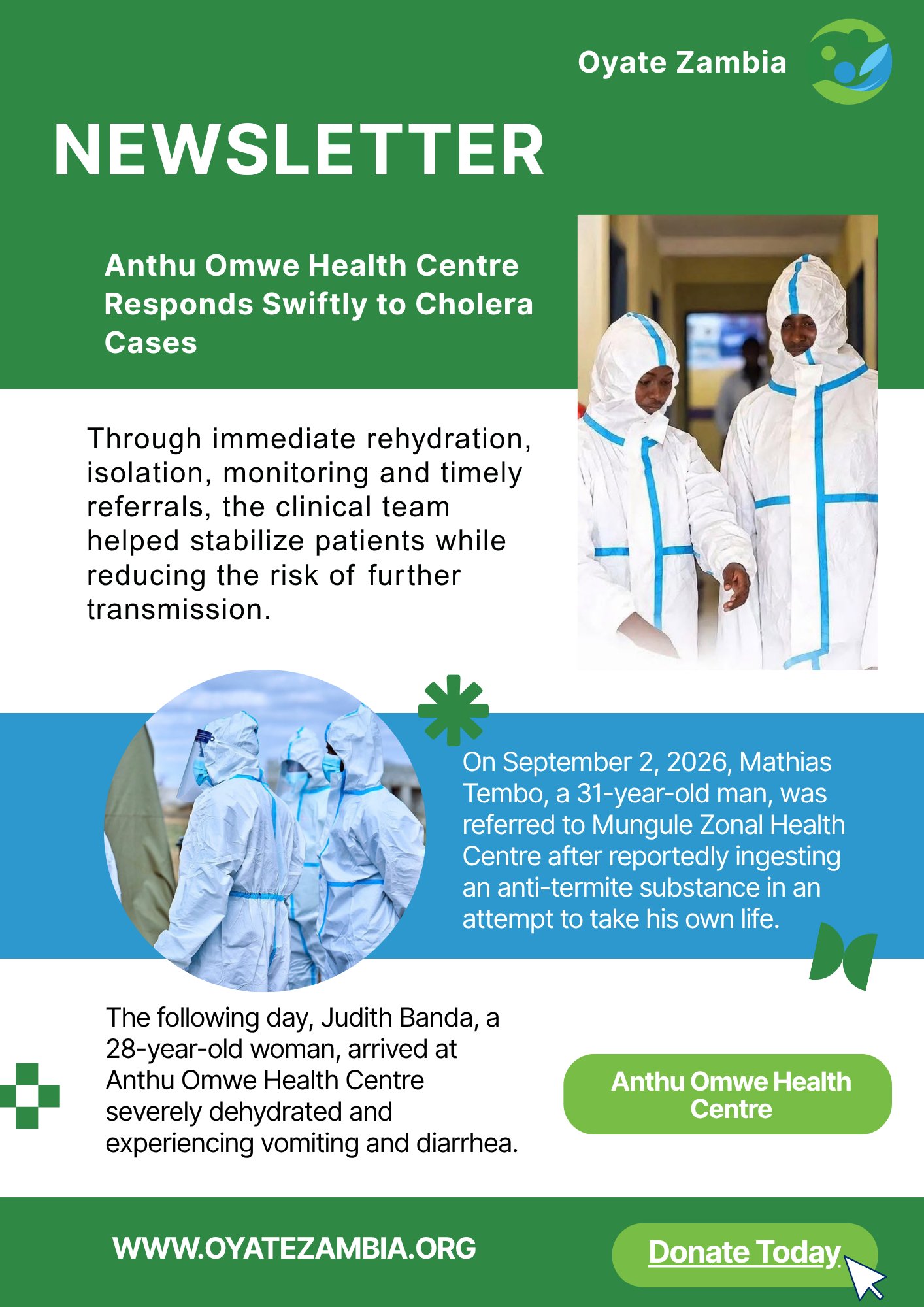
In early September 2026, the Anthu Omwe Health Centre responded swiftly to several suspected and confirmed cholera cases from communities surrounding Mungule. Through immediate rehydration, isolation, monitoring and timely referrals, the clinical team helped stabilize patients while reducing the risk of further transmission.
On September 2, 2026, Mathias Tembo, a 31-year-old man, was referred to Mungule Zonal Health Centre after reportedly ingesting an anti-termite substance in an attempt to take his own life. He was also experiencing severe diarrhea. Upon arrival at Mungule Zonal Health Centre, he was tested for cholera and received a positive result.
The following day, Judith Banda, a 28-year-old woman, arrived at Anthu Omwe Health Centre severely dehydrated and experiencing vomiting and diarrhea. The clinical team immediately resuscitated and rehydrated her before referring her to Mungule Zonal Health Centre, where she also tested positive for cholera.
On September 7, 2026, Kelvin Sibanda, a 72-year-old man from Namununga Chafuluma Village, was admitted at 09:00 hours. He was cared for in the facility’s cholera isolation bay for two days. Once his condition had stabilized, he was referred to Shafuluma Health Centre for continued management.
On September 8, 2026, Simon Manyumbelo, a 28-year-old man from Kadenke Village, was admitted at 10:30 hours and tested positive for cholera. He was immediately isolated and treated in the cholera bay. By September 9, he had recovered well and was discharged at approximately 14:00 hours.
Later on September 8, Michelo Charles, a 16-year-old boy from Kapolela Village, was admitted at 14:30 hours and tested positive for cholera. He received care in the facility’s isolation bay before being referred to the Chifwankula Isolation Bay on September 9 for continued treatment.
These cases demonstrate the critical role Anthu Omwe Health Centre plays in protecting rural communities. The availability of a dedicated isolation bay, trained healthcare professionals and emergency medical supplies allows the facility to identify, stabilize and manage patients before complications become fatal.
Cholera can spread rapidly through contaminated food and water, but it is both preventable and treatable. Community members are encouraged to drink safe or chlorinated water, wash their hands regularly with soap, cook food thoroughly, maintain clean surroundings and seek medical care immediately when vomiting or severe watery diarrhea begins.
The dedication of the Anthu Omwe Health Centre team continues to save lives. However, sustaining this lifesaving response requires a reliable supply of intravenous fluids, chlorine, protective equipment, testing materials, medicines and adequate staffing. Supporting the health centre means helping ensure that no person in rural Zambia loses their life because emergency healthcare was too far away or unavailable.
